
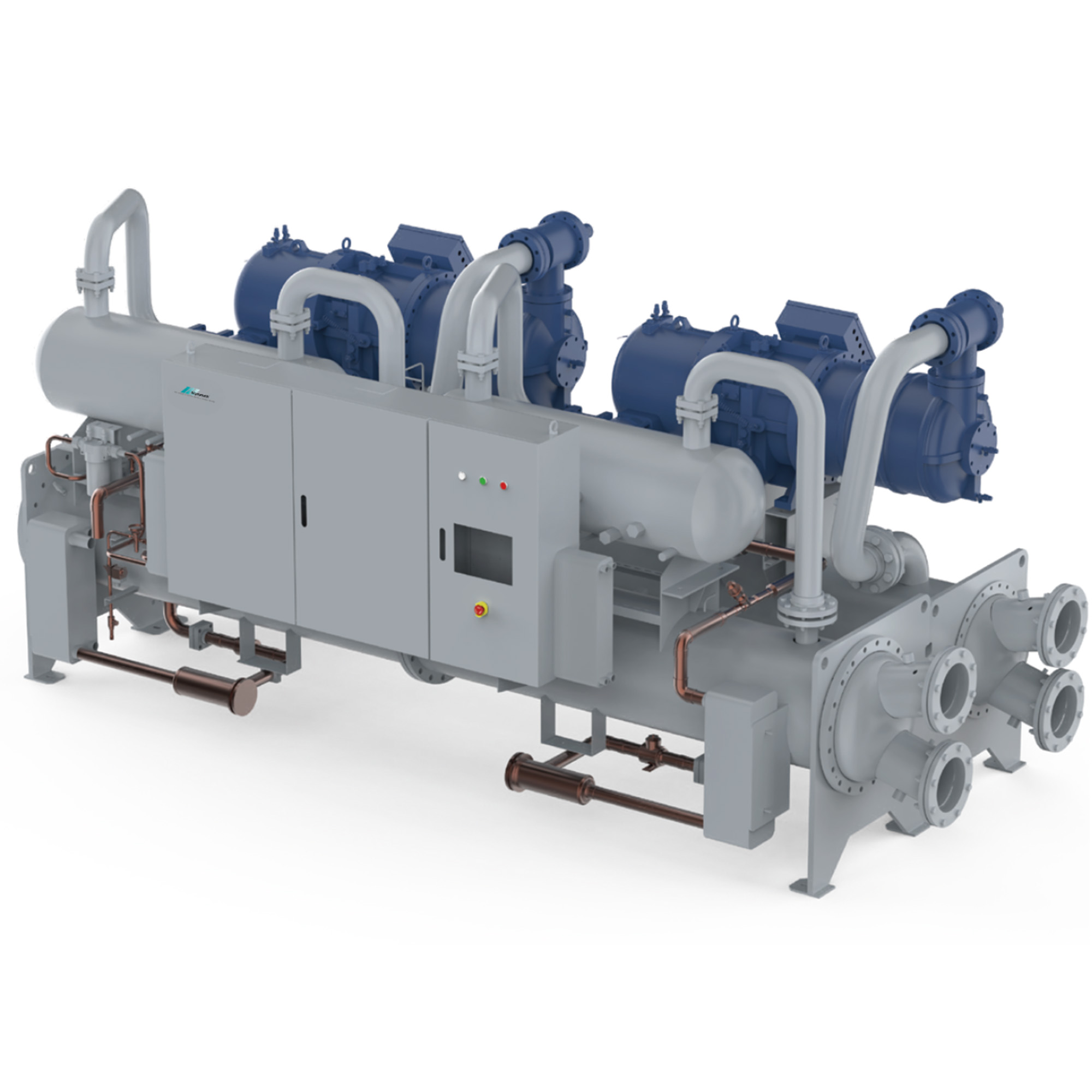
High-temperature screw-type water source heat pump unit The industrial high-temperature heat pump utilizes waste heat to produce 80–125°C hot water or 0.04–0.20 MPa steam, improving energy efficiency and reducing thermal pollution. It replaces traditional oil/gas and electric boilers with a compact, energysaving, safe, and easy-to-install solution. Ideal for industries such as lithium battery, oil refining, petrochemicals, food processing, textiles, and more.
Lifting hole
Reserved lifting holes for easy handling and transportation
Electrical Control Cabinet
Mammoth’s recessed design breaks the monotony of flat surfaces, creating a dynamic and futuristic aesthetic.
8"/10" color display screen
Unit status is clear at a glance, with easy operation and maintenance.
Microcomputer Control System
Equipped with functions such as self-diagnosis, automatic adjustment, safety protection, and remote control.
Compressor
Semi-hermetic screw compressor with a new rotor profile; enclosed motor cooled by refrigerant suction.
Electronic Expansion Valve (EEV)
Precise control optimizes system performance and accurately regulates outlet water temperature.
Evaporator
Designed with a uniform liquid distribution plate to optimize temperature distribution and enhance heat exchange efficiency.
Same-side Inlet and Outlet Design
Easy installation, cleaning, and maintenance.
Shell-and-tube condenser
High heat exchange efficiency and excellent cooling performance.
| Liquor Industry | In the traditional solid-state liquor brewing process, steam at ≥120°C is typically generated by boilers for grain steaming and brewing. Meanwhile, processes like wine pickling and cooling release large amounts of waste heat (≈90°C), leading to thermal and water pollution. By using a high-temperature steam heat pump unit to integrate waste heat with heating demand, a fully closed-loop heat recovery and reuse system can be achieved—enabling energy savings, emission reduction, carbon footprint reduction, and improved efficiency. |
|---|---|
| Beer Industry | In the beer brewing process, steam (≈100°C) required for brewing, boiling, and related steps is typically produced by boilers, while the cooling stage generates a large amount of low-grade waste heat (≈50°C) that is discharged via cooling towers. A high-temperature steam heat pump unit can recover this waste heat and convert it into high-temperature steam, which is then used for saccharification and boiling, greatly enhancing overall system efficiency. |
| Textile Printing & Dyeing | Printing and dyeing plants discharge large volumes of effluent at roughly 45°C while printing, dyeing, and rinsing lines operate simultaneously. These processes need 85–95°C hot water, typically supplied by boilers. Installing high-temperature heat pump units lets wastewater heat be reclaimed and upgraded, meeting hot-water demand while sharply cutting thermal discharge and humidity released to the environment. This approach significantly cuts fossil-fuel use and lowers soot, SO₂, NOx, and related emissions—delivering substantial environmental and social benefits. |
| Building Material Industry | In concrete pile production, steam below 200°C is needed after pouring to cure the concrete. Traditionally, this steam is generated by gas-fired boilers. During curing, wastewater at approximately 55°C is produced, contributing to both thermal and water pollution. A high-temperature steam heat pump system can recover this waste heat and reuse it to meet heating demands, thereby reducing primary energy consumption, lowering carbon emissions, and improving production efficiency. |
| Dairy Industry | Yogurt production requires high-temperature hot water at 80–85°C for cleaning, which is typically supplied by boilers. Meanwhile, during the initial cooling stage of pasteurized milk, a significant amount of waste heat at around 37°C is released. By using a high-temperature heat pump to recover and integrate this waste heat, energy consumption can be reduced, emissions lowered, and overall system efficiency improved. |
| Paper Industry | The dryer section of a paper machine in the paper industry requires steam below 0.3 MPa (≈133.5°C) for pulp drying, typically generated by boilers and transported over long distances by power plants. During production, a large volume of high-temperature wastewater (around 80°C) is cooled and discharged into cooling towers. Using high-temperature heat pump systems to recover and reuse this waste heat can significantly reduce production costs. |
| Printing | Decorative roll printing machines require high-temperature gas drying between 150–170°C. After printing, the coil surface emits exhaust gas at 80–90°C, resulting in substantial heat loss. A high-temperature steam heat pump system can recover this heat and transfer it to the fresh gas stream needing heating, thereby reducing dependence on the main heat source and improving overall energy efficiency. |
| Electronic Industry | In lithium battery production, 43% of the total energy consumption is used for dehumidifying the environment. Currently, the dew-point number dehumidifier requires a large volume of high-temperature heat (≈65°C) that is discharged directly outside, wasting heat. A high-temperature steam heat pump can recover this energy and reintegrate it into production, greatly improving energy efficiency and reducing costs. |
Download the catalog to view specifications for other models.
| Project Name | Hot Water Side | Source Water Side | ||
|---|---|---|---|---|
| Outlet Water Temp(°C) | Inlet-Outlet Water Temp Diff (°C) 3~30 |
Outlet Water Temp. (°C): 15~40 |
Inlet-Outlet Water Temp. Diff. (°C)3~15 |
|
| Medium Temperature Operating Range | 60~85 | Temp Diff (°C) 3~30 | Outlet Water Temp. (°C): 15~40 | Temp. Diff. (°C)3~15 |
| High Temperature Operating Range | 80~120 | Temp Diff (°C) 3~30 | Outlet Water Temp. (°C): 40~80 | Temp. Diff. (°C)3~20 |
SUBSCRIBE NEWSLETTER